
There is a kind of powerless frustration familiar to teaching writing. It is a series of pyrrhic victories, like untangling an intricate chain only to find another catch. How can a child use capital letters perfectly well in one sentence and forget that they exist in the next? And when you think you’ve solved that problem (you haven’t), they abandon their use of full stops or ignore everything you ever taught them about speech marks. Marking a piece of writing can leave us feeling overwhelmed, despairing over which stubborn knot to tackle first.
This frustration was at the front of my thinking as Head of English when our GCSE Language results dipped in 2018. Looking at the scripts of students who had achieved below their predicted grades, a pattern emerged. Their writing lacked clarity and coherence and was littered with SPAG mistakes. This triggered changes in how we teach writing. Short term, I used the examiners’ report and exam board exemplars to make sure our teaching fitted more closely to their examples of best practice. From this, I introduced whole department strategies like ‘Track the Text’, a mantra instilled in our students so they move through the comprehension extracts chronologically and meticulously. I created writing frames that students used for repeated practice and learnt and replicated in the exams (available here).
These strategies contributed to an improvement (a 22% rise in grades 9-5) but, in the long term, I didn’t just want to train our students to write according to a GCSE specification. I wanted students to arrive at KS4 with a knowledge of writing structures and foundations that would allow them to write more creatively. By KS4, I want students to spend more time focusing on satire than SPAG.
Understandably, KS3 planning often starts with KS4 aims and works backwards, but we need to look both ways. We are lucky enough to have one of the school’s Transition Leads working in the department, a primary trained teacher who takes Year 7 and 8 classes and maintains strong links with our feeder schools. By developing my understanding of how they teach writing at KS2, she has guided my thinking on how we could improve our approach:
- Invest more time on the component parts of writing: vocabulary, sentences, paragraphs, whole-text structure
- Build on students’ KS2 knowledge and maintain the high standards in presentation and accuracy from primary
- Complete fewer extended writing pieces and spend more time preparing, planning, editing and redrafting
A New Year 7 Writing Scheme
With this in mind, I reviewed the writing scheme that runs throughout Year 7 (one lesson a week) so that rather than writing lots of full pieces, potentially hard-wiring errors, students build towards one full piece at the end of each term. This allows time for the explicit teaching of nine sentence types (pictured below) based on the Alan Peat sentences used by our feeder primaries.

Each session (this could take longer than one lesson) follows a routine of deliberate practice with a focus on scaffolding and routine:
- Step 1: explanation and examples
- Step 2: whole-class practice
- Step 3: independent practice
- Step 4: editing and redrafting

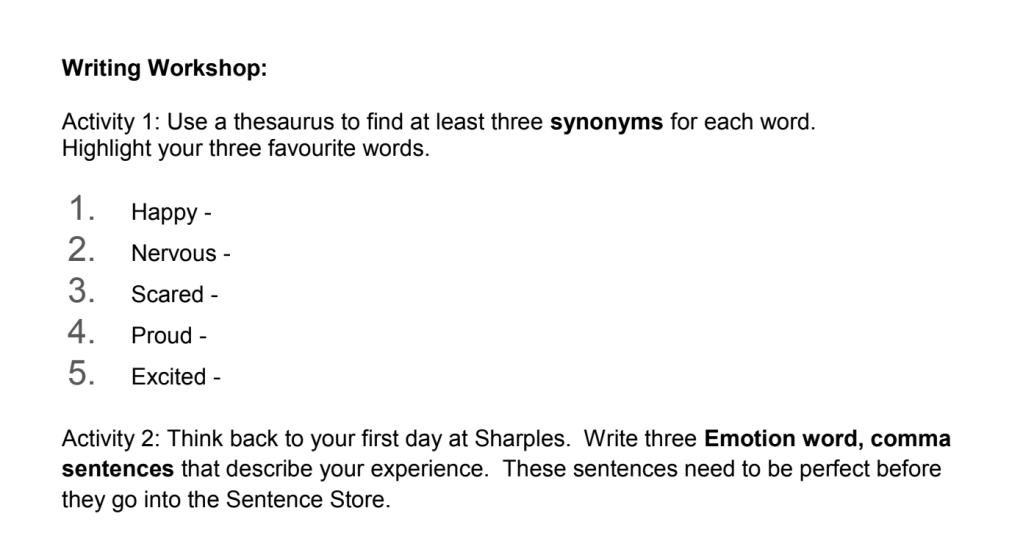
I decided to ground the writing tasks in the context of the school. The transactional writing tasks that filter down from KS4 can be removed from children’s experiences or create an unlevel playing field of required background knowledge. Instead, in this scheme students are writing about what they know, e.g. a speech about the enrichment programme that all our Year 7 students participate in. My hope is they are less impeded by a lack of background knowledge and have more cognitive space to focus on accuracy and habit-building. By asking them to write about the school and their own experiences, we are helping them build emotional links to its traditions and routines and form greater confidence in the new setting.
Planning for Common Errors
We already know the barriers that stop KS4 students producing good writing independently, so now we are seeking to preempt these early on. At KS4, students often don’t know how to plan their writing or think this is a step they can skip so the new scheme teaches planning strategies such as the Single Paragraph Outline from The Writing Revolution and how to build a paragraph that begins with a topic sentence and is developed with supporting details.
I have lost count of the amount of times I’ve yelled “make sure you proofread” at a class (or into the ether for all the good it did). Instead of this seemingly futile reminder, we now teach students how to edit and redraft, with a ‘workshop’ section for practising a sentence type or punctuation rule. At this point, verbal feedback can be precise: “The comma needs to always come after the noun in this kind of sentence.” Once mastered, students then write a ‘perfect’ version of their sentence into their ‘Sentence Store’ ready to use in their extended writing. I am hoping this will make students more aware of their accuracy and build high expectations for their own writing.
Focus on Knowledge
Teaching writing can be plagued with vague feedback: ‘develop this’, ‘make clearer’, ‘add detail’. But teaching writing as knowledge such as sentence types and punctuation rules gives students a concrete understanding of how to improve. Teachers are now able to give actionable feedback based on correction, e.g. “Fix this by looking back at the rules for direct speech punctuation” or target setting, e.g. “Next time use a verb, person sentence.” From Year 7, teachers and students have a shared language that can be revisited, retaught when necessary and built upon.
I wrote about the changes we are making to the way we teach academic writing here and the next step is mapping out the sentence structures we want students to master by the end of KS3. There is no single solution to the tangled frustrations of writing instruction, but looking backwards can help us loosen the knot.
Resources:
Year 7 Writing Booklet pdf:ks3-writing-skills-booklet-1Download
Year 7 Writing Booklet editable:ks3-writing-skills-booklet-1-1Download
Year 7 Writing PowerPoint slides:year-7-writing-scheme-1-1Download
 Finding Our Words