
As a secondary school teacher of English for a decade, having a growth mindset and expecting the same of others has always been central to my approach to business and leadership. Now entering my eighth year of entrepreneurship and reflecting upon what those years have taught me, I can see how many of my skills have transferred directly across from the days in the classroom to the boardroom.
“You can’t connect the dots looking forward; you can only connect them looking backwards. So you have to trust that the dots will somehow connect in your future. You have to trust in something–your gut, destiny, life, karma, whatever. This approach has never let me down, and it has made all the difference in my life.”
Steve Jobs
My 5 top transferrable skills taken directly from the classroom into business.
- Narrate the journey. As humans, learning from stories told to us is embedded into our DNA. We remember more from pictures being painted through language than we retain from facts and figures alone and in teaching, selling the story of the journey from A-Z and everything in between was crucial in keeping students motivated. Self-reflection of their whereabouts on that journey, at any given time, was a tool I used regularly to celebrate successes, boost confidence and crucially refocus students who’d gotten off track. Classroom-boardroom transfer? Your clients and team have the same human need to know where they are at on their own personal journey. Don’t we all! Outlining that beginning, middle and end along with the highs, lows, and all the potential bumps in the road will help to manage expectations and align visions from day one. It’s key to encourage people to fall in love with the journey and process rather than only valuing the destination. This can also help your talent not get derailed from failures or competition and instead anticipate these pit stops as opportunities to stop, reflect and push through.
2. Know your outcomes: Data is a huge part of education. You learn very quickly that analysing data trends both in your own classroom, across the whole school and other schools, supports your planning and teaching in staying flexible and relevant as opposed to continuing down paths that may be less fruitful. Learning how to dig deep into grades, levels, sublevels to then use that information as a springboard for my own development was invaluable and is something I’ve taken with me firmly into my business approach. Goals without any sense of data-led outcomes are woolly, vague and easily forgotten about. Tangible outcomes that can be tracked and monitored will help you prioritise, action your ideas and build up a picture of your team’s skillset to establish where, when and how best to invest more time and energy. You DON’T want to become purely data focused so that you lose the sense of purpose. It’s key that people come first and your purpose is always held at heart but once that firmly in place, you can begin your bench line data up to catapult your people to success.
3. The power of meetings: I’ve learned more from bad meetings than I have from good meetings in my ten years of teaching. We’ve all sat in meeting where we feel we’re being spoken at for hours on end and find ourselves coming away with little more than a grocery list and some grumbles on the way out. It’s easy to feel that meetings are taking time away from us and to therefore enter with a negative mindset, automatically setting the host up to fail. Eight years into my business, I’m still now building my own expertise in this area so with that in mind, I will add the caveat that this is not a critique of less successful meetings; not everyone has the time, energy and resources to invest into capitalising in this area. In hectic environments when the pressure is on, it’s understandable that sometimes a meeting needs to be a simple opportunity to disseminate information. That being said, if you do have the time and drive into developing a meeting strategy, I would hugely recommend this as time well spent. In teaching, you work incredibly hard to create a culture inside your own classroom. Giving others a voice and chance to engage is central to creating that sense of community. In business, meetings are your face to face, hands on opportunities to create the culture and ethos that you want for your company. It’s a huge area to learn about but my top tips would be: share clear agendas in advance to promote preparation and clarify expectations; encourage other voices to engage and lead; set clear timelines; keep it human.
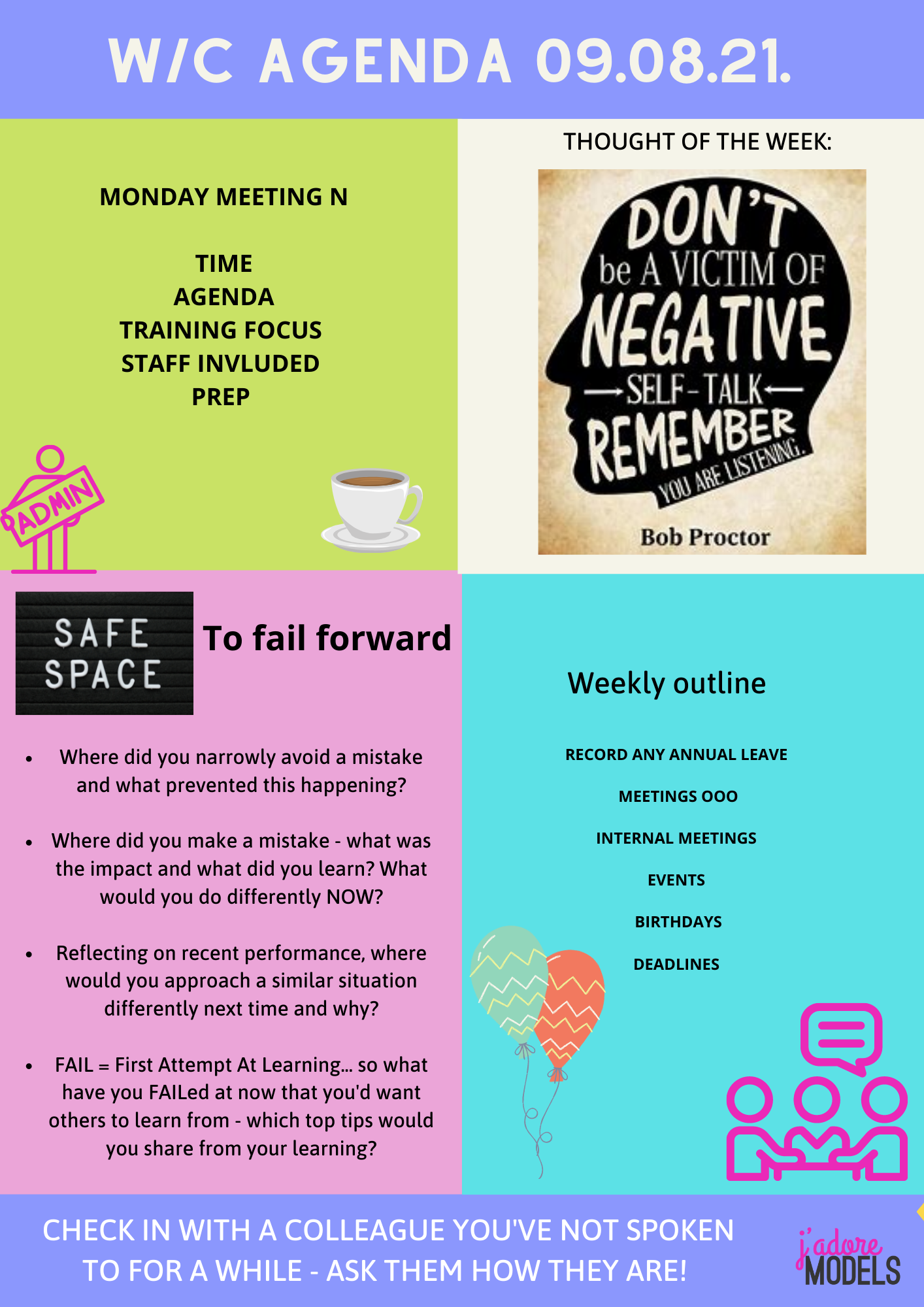
Quick tip – build a template for your meeting agenda – see my basic guide below that outlines quotes to reflect on, wellbeing tips, planning around each day, personal reflection prompts and training prep support.
4. Language is everything: now of course I’m biased here. English teachers will happily evangelise on the power of language being able to change the world (quite rightly so!) as a daily skill is using several layers and levels of language to differentiate for and communicate to, varied learners. Without the skill of carefully selecting your words, analogies, questions and feedback styles in a consistent manner to reassure and challenge, the battle is lost. How does this link to business? In precisely the same way, as a leader of people, taking the time to communicate your values and messaging is priority. You want your team to feel safe in your environment and we create our cultures through a mixture of actions and words. Knowing how to select your questioning, repeat your key points, offering candid and professional honest feedback and support with genuine interest all comes down to the words you use. One key tip would be: don’t say what you’re NOT doing – say your genuine intentions. E.g. turn ‘I’m not lecturing you…’ to ‘I’m investing the time to support you..’ Be as authentic and straight forward as you can and it will go further than you think.
5. Have the highest expectations: This doesn’t mean expecting perfect outcomes. It does mean expecting the highest commitment to engage in the processes that drive towards success. In education, the majority of this focus is setting clear boundaries around behaviour, the dos and the don’ts and championing those every single day. Is that tiring? Hell yes! Do you have to sweat the small stuff? Yes! But staying firm in those boundaries breeds incredible resilience, discipline and determination from young people. OK, but this is business, not teaching… I hear you, don’t worry! The good news is that your team will come to you with their own baseline level of professionalism which means your starting point may already be incredibly high – however standards can slip when people lack confidence and drive so it’s on you, as a leader, to expect the best. What does that actually look like? It could literally mean rather than accepting lateness or lack of prep in meetings; instead expect engagement and quality contribution, support with feedback frameworks or reflection questions and direct discussion to those you want to hear more from. When we expect too little from people or accept standards lower than our genuine ideal, we do them a disservice and no one wins. Making the ideal standards the norm, means you’re investing long term in your people to establish professional pride.

If you’re in education or business, I’d love to hear your feedback on transferrable skills. Perhaps you’ve moved from one industry to something entirely different – if so, get in touch and let me know your takeaways from one to another.
 Finding Our Words