
Is it a female thing? A millennial thing? A British thing? Or just a me thing? Why is it some people exude natural confidence and hold their own when talking, leaving their listeners pumped, clear and full of respect; whilst I still seem to waffle and witter my way around my key messages, adding unnecessarily goofy dad-jokes at every possible opportunity.
Self-deprecation is a bad habit that I once thought had its place in my work; and perhaps during a decade of teaching at secondary school, it did serve me well in positioning a non-threatening presence to get the most out of reluctant and insecure kids… but now, as a CEO of a small business with a team of 14 employees, 280 models and a global client base, it’s had its time and I’m learning to say goodbye to the put-downs as much as possible. There’s not taking yourself too seriously vs. not taking yourself seriously.
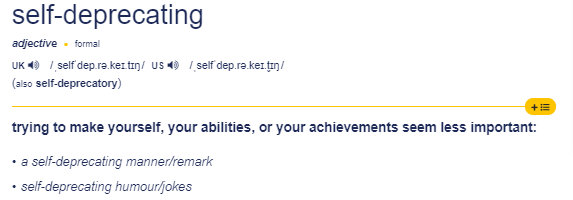
Self-deprecation: what I once thought was charm and humour, I now see as a habit of insecurity and people-pleasing leaving your listener confused as to your messaging.
How we talk to ourselves in every moment colours and shapes every reaction to our words, every interaction we have and every relationship we’re fostering. When we’re not showing confidence in our own values and beliefs, it shows. The ridiculous thing is, 9/10 times, I use self-deprecation even when I absolutely DO have full confidence in what I’m saying. So why undermine myself so quickly and consistently with such tiny yet highly damaging phrases?
I suppose the answer is simple: it’s a habit. One I’m aiming now to kick. With a tendency to people-please and put other people’s feelings above my own in the moment, I’ve previously used language as a way to bond others together and show my support / empathy but then been left utterly confused, and let’s face it, pissed off, when I’ve not felt heard or respected as a result. This post isn’t to say that humour and being able to laugh at yourself or be honest about vulnerabilities doesn’t have its place; but for day-to-day communication, I’ve come to recognise that clarity and confidence hold more value overall in leadership.
Now to be clear, I’m no fan of over confidence. Whilst I hugely admire great speakers and leaders, I’m turned off massively by arrogance and believe in an old-fashioned earning of stripes to really buy into the person I’m listening to. Rightly or wrongly, bluster without substance feels like a waste of time. Perhaps though, in a bid to avoid being perceived as braggadocious (yes, bold word choice) I’ve swung too far the other way and now I want to find balance. Who’s with me?
12 phrases I’m learning to audit in my daily vocabulary:
- Sorry Say this when you need to be genuinely sorry of course, but do you need to apologise for having a different opinion to your colleague? For taking 5 minutes longer in a meeting that holds value for the full team? For expecting a lot of others?
- Am I making sense? I bloody should be; I’ve prepped this conversation / presentation / meeting enough! I know my purpose and audience, I’ve done my research and groundwork and agonised over my language and style. So instead of asking a question that in one swoop undermines all your hard work, rephrase it to ‘Is that clear?’ ‘Do you have questions?’
- Just…only… Ugh, I hear these troublesome four letter words sneak out of my mouth constantly. ‘Just me…’ ‘Only a quick one…’ If ever there was a way of positioning yourself as entirely unimportant then there it is.
- Hopefully…fingers crossed…Don’t undersell all the work you’ve done and your expertise. Of course you can’t wave a magic wand over every situation but hold your nerve with your expectations of outcomes, stating instead ‘I would expect xyz to happen… from my experience we’re likely to see…’ it’s a tiny change but stay in control of the situation.
- I’ll try… If you’re like me, you probably use this to manage expectations and address the point that you can’t guarantee outcomes, as no one can. But I’ve learned that no one wants to hear that reality, nor does anyone need to. It suggests a limit to our commitment or efforts which does yourself a disservice. We do live in a soundbite culture, the nuts and bolts of processes, systems are not the shiny parts of conversation that your listeners want to hear. I’ve undermined and destroyed more responses to good intentions than I care to count by being too robotic and worried about giving false promises however I now realise that doing your best is all you can do.
- I can’t…You more than likely can. If you can’t there will be a reason, an obstacle – something that should be outlined. Outline the thing, not you.
- I think…I feel... You’re stating the obvious, of course you think, we’re all thinking – everything is only ever a thought or a feeling! Don’t undermine a fact, a well-researched or well-grounded position by starting with I think or I feel…
- No worries…no probs…no biggie…no big deal…If people don’t respect your time then they don’t respect you. I read this a while ago and it really stuck with me. People won’t respect your time, your energy, your words if you frame them as unimportant.
- Is this ok? / If that’s ok… If it wasn’t ok, reasonable, fair, just, you wouldn’t be asking. Trust in your integrity and stop worrying and checking in on basic tasks set. ‘Please’ always has a place but direct instructions are more fair for everyone invovled.
- I’m confused. This is a killer. Wow. What a way to look unnecessarily ill-informed or even to insult the speaker. These two little words have the power to antagonise and drive gulfs between spkear and listener; be specific about the areas your want further clarity on. Check your understanding ‘Am I be right in saying that you think XYZ…?’
- This might be a stupid question… If it is, why are you asking it? Deep down you’ll know why you’re asking, so again, check your intentions and if all’s good – ask the question without the preface.
- Sorry to nag…pester…nudge…push…bother you… Stop stop stop stop stop stop stop.
These are just a handful of regularly used phrases that do nothing to serve me – I’d love to hear yours but the trouble can often be recognising our own patterns and tropes. Jo Emerson, 2019’s International Coach of the Year, suggests enlisting the help of a friend to feedback on your language and act as a critical pal. I’d absolutely recommend asking for this kind of support, perhaps before your next presentation ask a colleague to listen to your run through and audit it for unnecessary self-deprecation.
Reminder: this isn’t just another stick to beat yourself with, another thing to ‘be better at’. It’s just an opportunity to reflect on your language and self-esteem to remove embedded critics that we all carry around with us. You won’t be able to perfect your communication word-by-word, just make peace with that and instead commit to noticing it and actively aiming to use stronger, bolder language to do yourself the justice you deserve.
Further reading:
How to Eliminate the Self-Deprecating Beliefs That Are Holding You Back (wellness-institute.org)
Title image taken from: ‘Just Not Sorry’ Makes Your Emails Sound Stronger More Confident (businessinsider.com)
 Finding Our Words